Authors: Lidea Shahidi¹, Caleb Lee¹, Robert Carlyon¹, Tobias Goehring¹
¹University of Cambridge
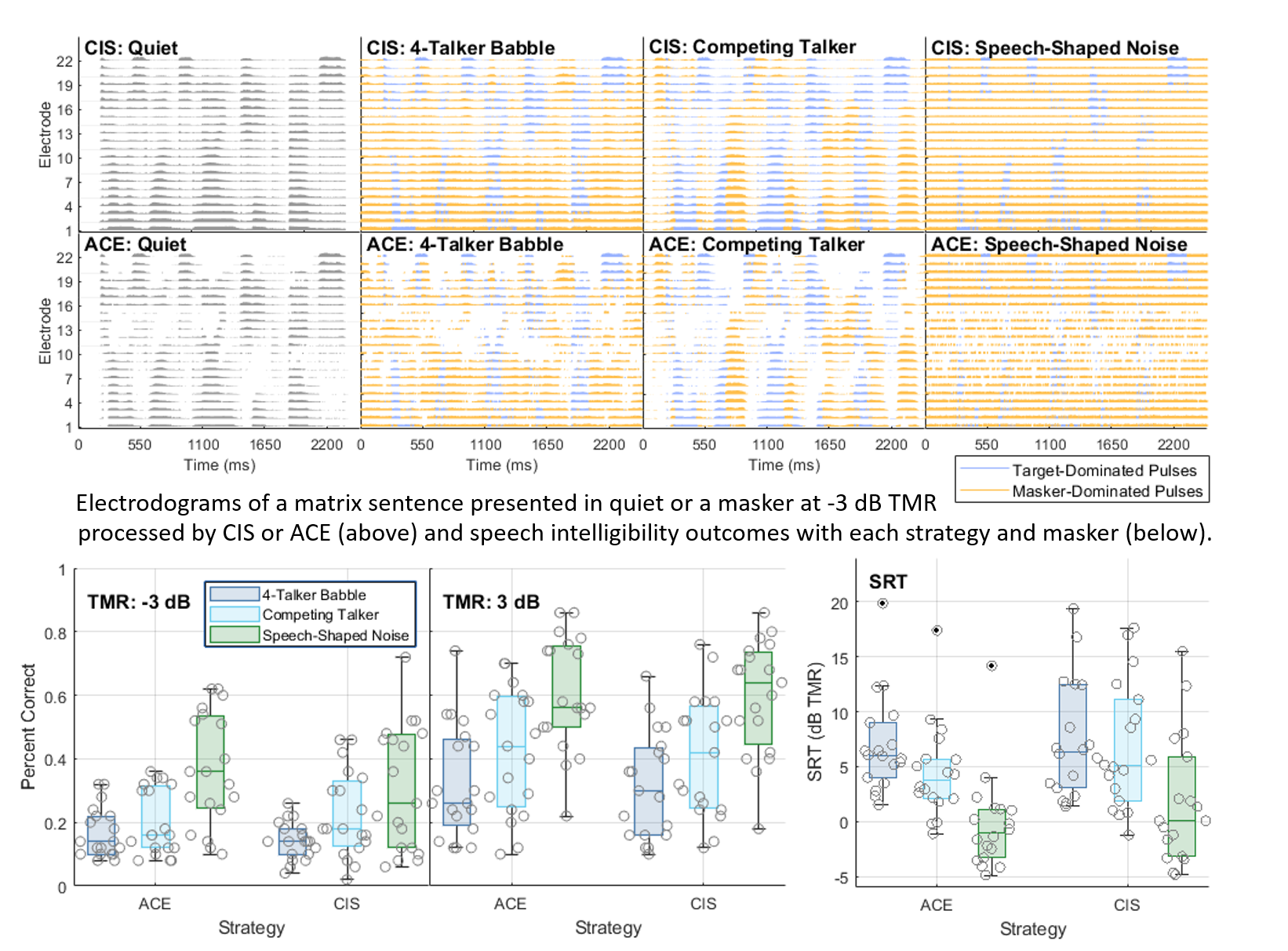
Background: Speech perception remains challenging for cochlear-implant (CI) recipients in background noise. Envelope-based CI processing strategies stimulate either all electrodes, as in the case of Continuous Interleaved Sampling (CIS), or use channel selection to select a subset of electrodes, as in the case of Advanced Combination Encoder (ACE), which selects the electrodes with the highest energy. Previous studies found that ACE improved speech intelligibility over CIS, but these studies tested intelligibility at positive target-to-masker ratios (TMRs) with relatively stationary maskers, where ACE likely selects target-dominated pulses. Considering that real-world listening conditions often contain non-stationary maskers, such as competing talkers, in which the instantaneous TMR fluctuates, this study investigates the possible interaction between strategy and masker type on speech intelligibility.
Methods: To isolate the effects of channel selection, this study tests typical-hearing listeners using a vocoder that simulates electrical current spread. Experiment 1 (N = 10) measured psychometric functions of speech intelligibility by TMR for three maskers: speech-shaped noise (SSN), four-talker babble noise (BB), and a competing talker (CT), informing measurement precision of speech reception thresholds (SRTs). Experiment 2 (N = 18) measured speech recognition at two TMRs (+3 and -3 dB) and SRTs across the three maskers and two strategies (CIS and ACE). Both experiments used the UK matrix sentence test.
Results: In experiment 1, psychometric function slopes were comparable across the three maskers. In experiment 2, a strategy-masker interaction was observed in SRT measurements, with SRTs in CT improving for ACE but not for CIS, but not at fixed TMRs. Both strategies demonstrated similar trends in speech intelligibility across maskers, with worse performance in BB and best performance in SSN.
Conclusions: Channel selection does not appear to impact speech intelligibility for the maskers and TMRs studied.